Opinion: Expanding career pathways for all requires investment in community-based organizations
The CBIA Foundation’s new report, Connecticut Workforce & Education Strategy Blueprint, makes a compelling case for improving high school career pathway programs as a means to strengthen the state’s workforce pipeline and expand economic opportunity in Connecticut.
The report offers a clear set of recommendations to respond to gaps in the current landscape of these programs relative to market demand, informed by input from stakeholders statewide along with what we can learn from what’s working in other states.
But as the new Connecticut Career Pathways Commission launches in parallel to the publication of this report, it is critical to ensure we also prioritize the population of young people experiencing disconnection who are beyond the reach of such school-based programs.
In 2023, research commissioned by Dalio Education and produced by Boston Consulting Group revealed that 119,000 young people — one in five — are disconnected from school or work in Connecticut, or at risk of becoming disconnected. The most recent data from DataLinkCT, which replicates this analysis annually as required by legislation passed following the publication of Dalio Education’s report, shows that approximately 63,000 young people continue to experience disconnection from education and employment.
These young people have tremendous potential, and our state stands to benefit from an annual fiscal impact of up to $750 million if we reconnect them to the workforce. But to make that happen, our state needs to invest in the community-based programming that prepares young people impacted by disconnection to secure and sustain gainful employment.
At the Connecticut Opportunity Project, the social investment fund of Dalio Education, we have been investing in seven nonprofit organizations in Connecticut that are doing exactly this work. We provide long-term, unrestricted grant dollars along with organizational coaching and technical assistance to support our grantee partners in continually improving their programs and infrastructure so that they can successfully and sustainably reconnect more young people back to school and the workforce.
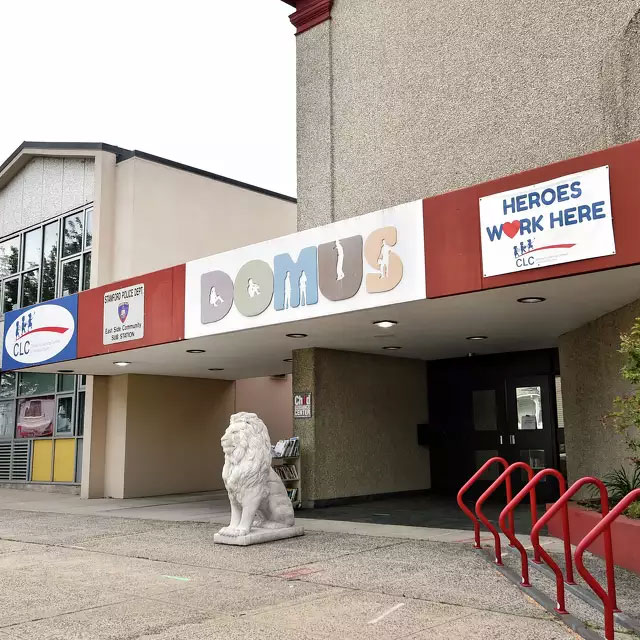
We know that these programs work. One of our nonprofit partners, Domus Kids in Stamford, recently completed an implementation and outcomes evaluation with Child Trends, the leading U.S. research organization focused on improving the lives of children, youth and families.
Child Trends found strong long-term outcomes for young people served by DomusWorks, the organization’s workforce development program.
Among program graduates, 96% were still employed full time with benefits one year later. These results come from a group of young people who, at the time of enrollment, were unemployed and faced an average of three or more obstacles, ranging from previous justice involvement and exposure to violence to difficulty meeting basic needs.
DomusWorks engages young people for as long as it takes to help them become willing, ready and able to succeed.
It begins by helping stabilize participants and address basic needs. The program then provides skill-building through paid experiential learning within the organization’s social enterprises. It continues with ongoing job coaching for the first six months after placement into unsubsidized external employment, while maintaining responsive wraparound supports throughout their journey with Domus.
As a parallel research project to the one produced by the Boston Consulting Group in 2023, Dalio Education had commissioned MDRC, a nonpartisan social policy research organization, to undertake a scan of programs, practices and policies across the country that help or hinder young people in reconnecting to school and work. This study focused on those who are reluctant to actively seek supports, and those who have been impacted by the justice system.
The MDRC report underscored that there are not nearly enough programs like Domus that serve the young people who need supports the most — a challenge not unique to Connecticut, but true nationwide.
Further, MDRC emphasized, for those programs that do exist, they are not adequately funded to do the level and quality of work necessary, over the time horizon required, to successfully re-engage young people who are disconnected.
Improving high school career pathways is an important component of strengthening Connecticut’s workforce pipeline in furtherance of expanding economic opportunity. But to reconnect the 63,000 young people experiencing disconnection in Connecticut, our state must also make a commitment to invest in the community-based programs serving those beyond the grasp of schools.
Amanda Olberg is deputy director of the Connecticut Opportunity Project at Dalio Education.